White hat SEO
White hat SEO follows search engine and AI platform guidelines: useful content, honest markup, open crawl access and links people choose to give.
Blog · October 13, 2026
Google started the November 2026 core update on November 10 and says it may take up to two weeks. For small businesses chasing cheap AI traffic, the right move is a baseline today, a few free quality checks, and no paid fix until the rollout ends.
Cheap AI traffic for a small business still leans on Google, and Google just started moving the ground. On November 10 at 10:06 a.m. Pacific, Google posted on its Search Status Dashboard that it had released the November 2026 core update, which applies globally and to all languages and may take up to two weeks to roll out. Search Engine Land notes that it is Google's third core update of 2026, after March and May, and that Google called it a regular update meant to surface relevant, satisfying content from all types of sites.
AI Overviews and AI Mode live inside Google Search, so a core update can change which pages Google leans on when it builds those answers too. That's also why ChatGPT-focused work overlaps with Google work: our sister agency ChatGPTKing looked at how ChatGPT names only about three brands in a buying answer when it names any, and the pages that win those few spots are usually the same clear, well-indexed pages that hold up in Google.
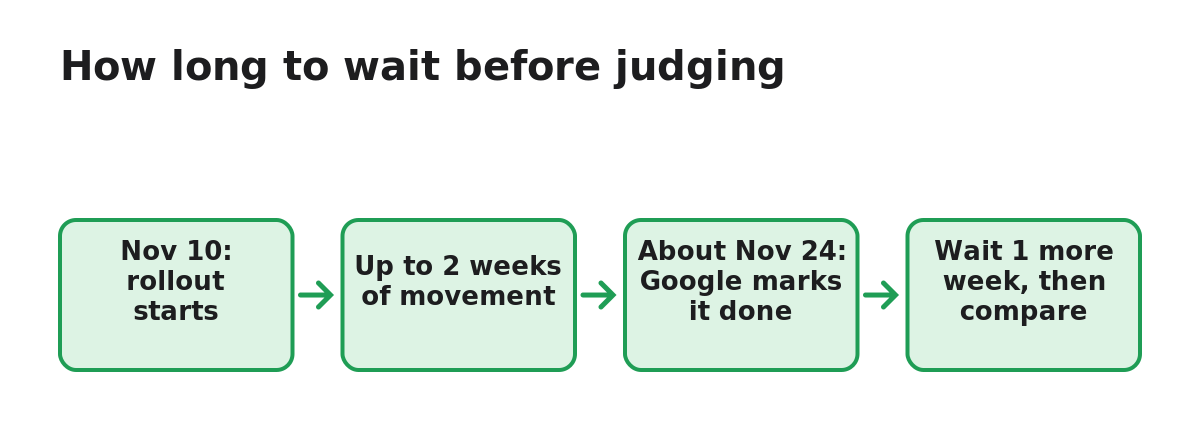
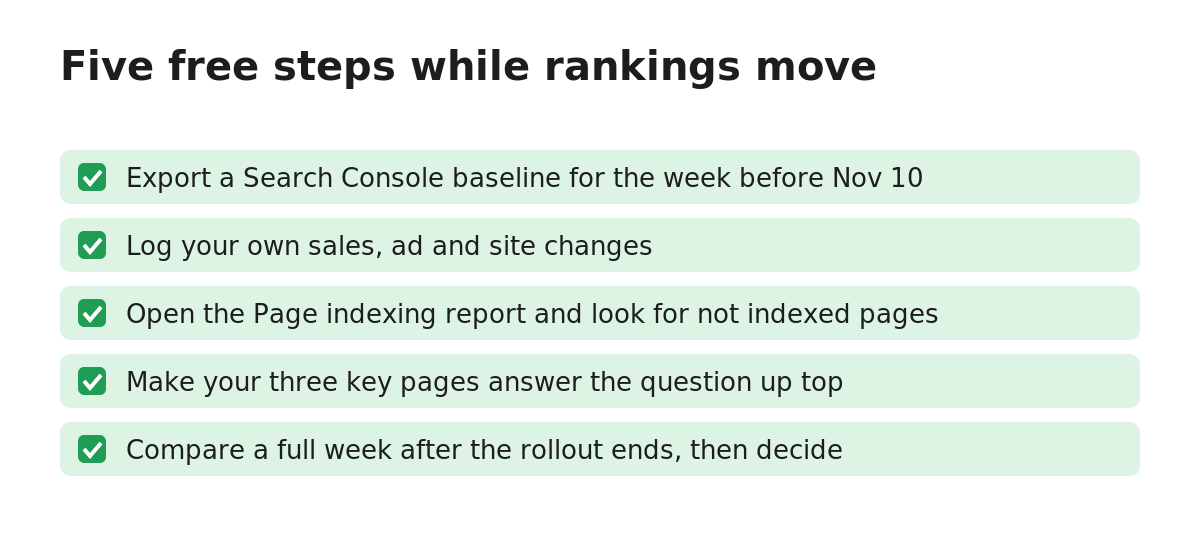
The expensive move during a rollout is panic: paying someone to rewrite pages, disavow links or 'recover' rankings while the update is still running. Google's guidance, as Search Engine Journal summarized, is to wait at least a full week after the rollout completes, then compare that week in Search Console with a week before it started. If the update runs the full two weeks, that lands right on top of U.S. Thanksgiving and Black Friday, so a shop comparing holiday traffic with an ordinary week can easily misread the result.
Google also says there aren't specific actions you can take to recover from a core update, and a drop may not mean anything is wrong with your pages. A small slide from position 2 to 4 rarely needs work. A sustained fall deserves a closer look, after the dust settles.
If you're weighing outside help afterwards, BuyAISearch has a fair comparison of whether an agency or a GEO platform suits your budget, including tools you'd run yourself.
CheapAITraffic is built for small businesses that want AI visibility without a big budget, and that means telling you when not to spend. We don't sell core update recovery packages, bot traffic, fake reviews or guaranteed placements. We start with free checks like the plan above, our free AI discoverability audit shows what AI assistants can already find about you, and when a paid push is worth it we run AI search visibility campaigns delivered through neetbros aimed at the questions your customers actually ask. You can also follow neetbros news on AI discovery for the bigger picture.
Want this done for you? Start with our free AI discoverability audit. Campaigns are delivered through neetbros.
White hat SEO follows search engine and AI platform guidelines: useful content, honest markup, open crawl access and links people choose to give.
Black hat SEO tries to trick ranking systems with things like hidden text, link schemes, cloaking, fake reviews or bot traffic. It can work briefly, and it can get a site penalized or quietly ignored.
We're not black hat: no spam, no hacks, nothing that risks penalties. LLM search is still growing, and we keep up with the latest legit techniques. Stay tuned to our blog for free tips. Read the blog →